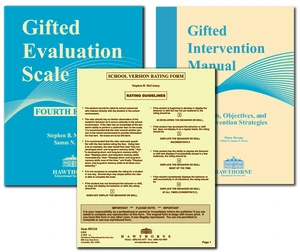
GIFTED EVALUATION SCALE
Third Edition
(GES-3)
by Stephen B. McCarney, Ed.D. &
Tamara J. Arthaud, Ph.D.
Copyright © 2009
The Gifted Evaluation Scale-Third Edition (GES-3) was developed to aid in the identification and program planning for children and adolescents in our schools. The scale consists of 48 items. Each subscale is associated with one of the five characteristics identified in federal and state regulations, including the Gifted and Talented Children’s Act of 1978 and the Jacob K. Javits Gifted and Talented Students Education Act of 1988.
The GES-3 subscales are Intellectual, Creativity, Specific Academic Aptitude, Leadership Ability, and Performing and Visual Arts. Results can be used to make decisions about eligibility, placement, and services in gifted and talented programs. An optional subscale, Motivation, has been developed to accommodate those states which require documentation of this characteristic in the identification process of gifted/talented students.
Internal consistency, test-retest, and inter-rater reliability; item and factor analysis; and content, criterion-related, diagnostic, and construct validity are reported in the technical manual. Following administration, five types of scores may be obtained: frequency rating for each item (reflecting the degree of success in performing a behavior), subscale raw score (the sum of the frequency ratings for each subscale), subscale standard score (a consistent basis for comparing students), percentile (a measure for comparing the student’s performance to the performance of other students), and a quotient score (a global index of all characteristics measured within the total scale). Using the subscale standard scores, a profile of the student’s level of functioning across the five subscales may be constructed.
Characteristics and Components of the GES-3
-
The GES-3 is based on the Gifted and Talented Children’s Act of 1978 (PL 95-561, Section 902) and the Jacob K. Javits Gifted and Talented Students Education Act of 1988.
-
The GES-3 was standardized on 2,288 students.
|
-
The standardization population included students from 16 states and represented all geographic regions of the United States.
-
The GES-3 was factor analyzed to create the factor clusters (subscales)
-
The GES-3 provides separate norms for male and female students ages 5 through 18.
-
The GES-3 can be completed in approximately 15 minutes and includes 48 items easily observed and documented by educational personnel.
-
The Gifted Intervention Manual includes goals, objectives, and interventions for all 48 items on the scale.
-
An optional subscale, Motivation, is available.
Educational Planning
The Gifted Intervention Manual (103 pages, © 1990) was developed to provide goals, objectives, and classroom instruction/intervention strategies for the enrichment of gifted and talented students in the regular classroom. The goals and objectives are based on the subscales and items of the GES-3. The interventions were developed primarily for implementation by regular classroom teachers to enrich the educational program of gifted students in the regular classroom. Once a student’s specific characteristics of giftedness are identified; the goals, objectives, and interventions can be chosen to help the student maximize his/her potential in the regular classroom.
|